Friday, November 14, 2008

Bangkok governor calls it quits in wake of corruption indictment


Bangkok governor calls it quits in wake of corruption indictment

BANGKOK, Nov 12 (TNA) - Bangkok governor Apirak Kosayodhin announced on Wednesday he had decided to resign from his post, one day after being found guilty in relation to alleged irregularities involving the Bangkok Metropolitan Administration (BMA) procurement of fire trucks and boats worth more than Bt6.8 billion in 2003.

Speaking to a press conference, Mr. Apirak, who was re-elected as BMA governor for a second four-year term on October 5, maintained his innocence and vowed to fight the corruption charges in court.

Mr. Apirak said that late Tuesday he had discussed his future with his family, opposition Democrat Party leader Abhisit Vejjajiva and other party executives and had decided to resign from his post after November 19 when the royal cremation ceremonies of the late Princess Galyani Vadhana, elder sister of King Bhumibol Adulyadej, are completed.

The royal cremation ceremonies of the late Princess Galyani Vadhana start this Friday.

At present, Mr. Apirak is also a deputy leader of the Democrat Party.

He said that it would be better for him to resign as the issue was being watched by society.

On Tuesday evening, the National Counter Corruption Commission (NCCC) unanimously voted him -- together with former prime minister Samak Sundaravej and nine others -- guilty of wrongdoing and violating the criminal code inthe scandalous purchase in which the now-disbanded Assets Examination Committee (AEC) had earlier charged that the 2003 purchase of fire trucks and boats from Austria's Steyr Daimler Puch Co had caused the state to lose more than Bt1.9 billion.

The AEC transferred the case to the NCCC on June 30, 2008, before its mandate expired, so that the anti-corruption agency could take further action.

In accordance with legal procedures, the NCCC would forward its decision announced Tuesday to the Office of the Attorney-General which will forward the case to the Supreme Court's Criminal Court for Holders of Political Positions since many of the wrongdoers were former politicians, so that legal action could be taken against them.

A new Bangkok gubernatorial election will be held within 60 days of Mr. Apirak's formal resignation. (TNA)

Political News : Last Update : 17:26:59 12 November 2008 (GMT+7:00)

Wednesday, November 12, 2008

The National Museum At Bangkok

Bangkok is home to an extensive and very informative National Museum, which claims to be the largest of it's kind in all of South East Asia. It serves as a good place to learn about the full range of Thai culture, history, and of the traditional significance of Buddhism to the Thai way of life. Many of the significant remains of the former capitals Sukhothai and Ayuthaya are displayed here, and if you're planning to go to them, a visit here first should be rewarding. Depending on your interest, a visit here could take anywhere between an hour or so up to most of a day.

There are free English language tours, lasting about 2 hours, available of the museum, starting at 09.30am on Wednesdays and Thursdays. On Wednesdays, tours are also available in French and Japanese, and in German on Thursdays. These are well worthwhile, else you may not understand much about any of the exhibits and their significance especially as some of the galleries are lacking in information.

6 buildings make up the National Museum. The first building, on the left as you come in past the entrance, is the Sivamokhapiman Hall. This contains the ticket office, and the galleries of Thai history and prehistory. This includes perhaps the museum's star exhibit, the Inscription No. 1 from the Sukhothai era. Supposedly written by the great King Ramkhamhaeng himself, it is regarded as the Thailand's first work of literature. It describes the greatness and prosperity of the Sukhothai kingdom, and the benevolence of the King. All Thai school children are taught the famous opening lines, 'nai naam mee bplaa, nai naa mee kao' (ในน้ำมีปลา ในนามีข้าว) meaning 'in the water there are fish, in the fields there is rice'.

Opposite here is Buddhaisawan Chapel (sometimes known as Wat Buddhaisawan). It was built in 1787, shortly after the founding of Bangkok and contains a very revered Buddha image, the Phra Buddha Sihing. The story of this tells of it floating to Thailand from Ceylon (Sri Lanka), but it is generally thought to have originated in Sukhothai. Identical images are also found in Nakhon Si Thammarat and Chiang Mai. It remains unknown which one is the genuine original. There are also impressive murals in here, starting from the right of the back door.

Other highlights of the museum include recovered jewelry and gems, giant shadow puppets, weapons, ivory, royal possessions, musical instruments, and Asian art and antiques through the centuries.

Details

Entry to the museum is 40B, and this includes a thin leaflet. A more comprehensive guide can be bought for 50B, and if you don't take a tour this is worth buying. The museum is open Wednesday to Sunday, 09.00am to 4.00pm, though tickets can only be bought until 3.30pm. It is located on Na Phra That road, next to Sanam Luang. Photography is banned inside the museum buildings.

Don't listen to anyone on the street as you try to enter telling you it's closed for a 'Buddhist holiday', 'cleaning' etc, or asking if you want to see the 'Lucky Buddha' instead - it's all part of a sophisticated gem scam.

The museum is just the other side of Sanam Luang from Wat Phra Kaew and Wat Pho, and just a small boat ride from Wat Arun. Some of the other sights in the Ko Rattanakosin area are within walking distance. The Banglamphu accommodation is very close to the National Museum. The nearest river express pier is Tha Phra Chan. The buses that stop on the west side of Sanam Luang are the closest to the National Museum. These are ordinary buses 15, 30, 32, 43, 59, 64, 80, 123 and aircon bus 39.

Monday, November 10, 2008

Wat Arun, Temple of the Dawn At Bangkok

The famous Wat Arun (วัดอรุณ), perhaps better known as the Temple of the Dawn, is one of the best known landmarks and one of the most published images of Bangkok. It consists of a massive elongated prang (Khmer-style tower), and is surrounded by four smaller prangs. The prang is described by the Tourism Authority of Thailand as 104m high, while most other sources quote figures around 80-85m. It is decorated by bits of porcelain which had previously been used as ballast by boats coming to Bangkok from China, a hallmark of the reign of King Rama III. The Wat had a brief period as host of the celebrated Emerald Buddha, which now resides in nearby Wat Phra Kaew.

The Wat really looks better from a distance than close up, and you're not missing out too much even if you only view from across the river. The grounds are fairly pleasant and peaceful though, with good murals and a main Buddha image supposedly designed by King Rama II. The mythical guardians here are also quite impressive, though very similiar to those at Wat Phra Kaew.

It is possible to walk a limited way up the (very steep) stairs of the main prang, which gives a reasonable view of the Chao Phraya river.

Despite it's name (coming from Aruna, the Indian god of the dawn), the best views and photos of Wat Arun are in the evening with the sun setting behind it. There are some restaurants on the opposite side of the river that are good for watching this, though you'd be lucky to see the image of Wat Arun that's on all the postcards - that of the red sky sunset with the sun setting directly behind the temple. Sunset is around 6pm - 7pm all year round in Bangkok.

Details

Wat Arun is a little unusual as it's really the only major tourist attraction on the Thonburi side of the river. It is open every day from 8.30am to 5.30pm. Officially, entrance to the Wat is 20B and the ferry crossing is 2B. Sometimes if you walk around the Wat grounds, you will be requested for a donation (with a book showing how everyone else gave 100B/200B), and sometimes the staff at the pier will cite some excuse and charge another 10B or so to let you through.

Other attractions fairly easy to reach from here are Wat Pho, Wat Phra Kaew, the National Museum, Chinatown the Ko Rattanakosin area, and the Banglamphu district.

Due to it's location, by far the best and most common way to get to Wat Arun is on the river. The Tha Tien express boat pier, at the southwest corner of the Grand Palace / Wat Phra Kaew, is opposite Wat Arun and boats leave every few minutes. You can get to Tha Tien on the Chao Phraya River Express boats from any other pier, or take a taxi to it. Buses that go near Tha Tien are ordinary buses 1, 25, 44, 47, 62 and 91 which stop on Maharat road. There are also plenty of Thonburi canal tours that go here.

Sunday, November 9, 2008

Wat Pho, Temple of the Reclining Buddha At Bangkok

Wat Pho (วัดโพธิ์), or Wat Phra Chetuphon (วัดพระเชตุพน) as it is generally known to the Thais, is mainly famous for the huge Reclining Buddha statue it houses. At 20 acres large, it is the largest Wat in Bangkok, and is technically the oldest too, as it was built around 200 years before Bangkok became Thailand's capital. However, today the Wat today bears virtually no resemblance to that originally constructed, as it was almost entirely rebuilt by Rama I when the capital was moved to Bangkok. It holds the dual honors of having both Thailand's largest reclining Buddha image and the most number of Buddha images in Thailand.

The highly impressive gold plated reclining Buddha is 46 meters long and 15 meters high, and is designed to illustrate the passing of the Buddha into nirvana. The feet and the eyes are engraved with mother-of-pearl decoration, and the feet also show the 108 auspicious characteristics of the true Buddha.

The large grounds of Wat Pho contain more than 1000 Buddha images in total, most from the ruins of the former capitals Ayuthaya and Sukhothai. The grounds are split in two by Chetuphon road. The northern section is generally the only one most people go to, and it includes a large bot (temple hall), enclosed by 394 bronze Buddha images. Outside the bot, there are 152 marble slabs depicting the second half of the epic Ramakian story. Also near here are fourGrounds of Wat Pho chedis, constructed to honor the first three Chakri kings (two for King Rama III). There are also a massive 91 others Chedis of varying sizes arounds the grounds, along with chapels, rock gardens, an array of different types of statues, inscriptions, belltowers and resident fortune tellers. The library is nearby too, decorated impressively with figures and pagodas made of porcelain, in much the same way as Wat Arun across the river. The much less visited southern section has less of interest, but makes a good place to find a monk to chat to for a while. Most would welcome the chance to practice their English on visitors.

Massage - Wat Pho is also famous as Thailand's first university, and is center for traditional Thai masage - the rich, famous and powerful have all been known to come here. Inscribed on stone in the walls of Wat Pho are all that was known about Thai massage dating from the reign of King Rama III (most previous texts were lost when the Burmese destroyed Ayuthaya)

To get a traditional massage here costs 150B for 30 mins, 250B for an hour and herbal massages are available at 350B an hour. If you want to experience traditional Thai massage, this is probably the best place available and is highly recommended, though be aware that it's not exactly a gentle experience. A foot reflexology massage is also available at 250B for 45 minutes.

It is also possible to take courses to learn traditional Thai massage. These are for 30 hours and cost 4,500B. Courses can be spread over either 10 or 15 days. The massage center is situated at the back of the Wat, the opposite side from the entrance. To get a massage, simply turn up here and wait in line until a masseur is available - perhaps 10 or 20 minutes in the quieter periods in the early morning and late afternoon. Contact them on (+662) 221 2974 or (+662) 225 4771 if you need any more information about it.

The Feet of the Reclining Buddha, Wat PhoDetails

The entrance to Wat Pho is on Chetuphon road. Entrance is 20B. It's open every day, opening hours are from 08.00am to 5.00pm, with a break from 12.00pm to 1.00pm. Guides can be hired at the entrance for 150B for one person, 200B for two, 300B for three, but they're not really needed. On Sundays, you can see students being taught traditional Thai dance and music.

Don't listen to anyone on the street as you try to enter telling you it's closed for a 'Buddhist holiday', 'cleaning' etc, or asking if you want to see the 'Lucky Buddha' instead - it's all part of a sophisticated gem scam.

Aircon buses 6, 8 and 12 all stop close to Wat Pho, and the Tha Tien express boat pier is very near. Ordinary buses that go near Wat Pho are ordinary buses 1, 25, 44, 47, 62 and 91 which stop on Maharat road. 44, 47 and 91 all stop on Thaiwang road, on the north side of Wat Pho, south of Wat Phra Kaew. It's also just a short river crossing away from Wat Arun. It's within walking distance of Wat Phra Kaew / Grand Palace, and (if you're feeling energetic) the National Museum too.

Saturday, November 8, 2008

The Grand Palace At Bangkok

The Grand Palace (พระบรมมหาราชวัง) adjoins Wat Phra Kaew in a common compound, and is where you will end up after exiting Wat Phra Kaew. Despite the proximity of the two, there's a distinct contrast in style between the very Thai Wat Phra Kaew and the more European inspired designs of the Grand Palace (the roof being the exception). The Grand Palace is nowadays used only for occasional ceremonial purposes and is no longer the royal residence. The present King Bhumibol (Rama IX) lives in Chitralada Palace (also closed to tourists), which is located not too far away in Bangkok's Dusit district. Though the interior of most of the buildings remain closed to the public

Highlights of it are:

- Boromabiman Hall, built by King Rama VI and every king since has lived here at some time.

- Amarinda Hall, the original residence of King Rama I and the Hall of Justice. Nowadays it's impressive interior is used for ceremonial occasions and coronations. It contains the antique throne, used before the Western style one presently in use.

- Grand Palace Hall / Chakri Maha Prasat. Visitors are allowed inside the spacious European style reception room. This building has not been used for royal residence since the mysterious death of King Rama VIII (the older brother of the current King), found shot dead in his room in 1946. The reverence for the monarchy in Thailand means that, even today, this remains a completely taboo subject to talk publicly about in Thailand.

- The impressive Dusit Hall, rated as perhaps the finest architectural building in this style.

- The Museum, which has information on the restoration of the Grand Palace, scale models of the Wat and Palace and numerous Buddha images. Labels are in Thai only, but there are free English tours available frequently. Entrance is 50B.

Details

The combined compound is open 8.30am to 3.30pm everyday. Cost is 200B (if you are Thai, it's free), and includes admission to Vimanmek Mansion and Abhisek Dusit Throne Hall, both in the Dusit area of the city, the Coin Museum in the compound, and so-so free guidebook. The entrance to the compound is on Na Phra Lan road, on the north side.

Don't listen to anyone on the street as you try to enter telling you it's closed for a 'Buddhist holiday', 'cleaning' etc, or asking if you want to see the 'Lucky Buddha' instead - it's all part of a sophisticated gem scam.

As Wat Phra Kaew is Thailand's most important temple, you are expected to dress appropriately or risk being turned away. Signs put up around the entrance show you are not permitted to enter wearing shorts, sleeveless shirts, singlets or any form of open ended shoes. Sarongs and long trousers are usually available for loan should you forget.

Other attractions easy to reach from here are Wat Pho, Wat Arun, the National Museum, others sights in the Ko Rattanakosin area, and the Banglamphu district.

There's plenty of options for getting to the Grand Palace and Wat Phra Kaew. Ordinary buses 44, 47 and 91 stop on Thaiwang road between Wat Pho and Wat Phra Kaew. Ordinary buses 1, 25, 44, 47, 82 and 91 also stop on Maharat road, on the west of Wat Phra Kaew. On nearby Sanam Luang, north of Wat Phra Kaew, ordinary buses 3, 15, 30, 32, 43, 44, 59, 64, 70, 80, 123 and 201 all stop, as well as aircon 6, 7, 12, 39 and 44. The Tha Chang river express boat stop is also very near. If you're staying in Banglamphu, it's possible to walk there via Sanam Luang. It's only about a 1 km walk, but involves crossing some large and busy roads which don't have any obvious crossing places.

Friday, November 7, 2008

Wat Phra Kaew, Temple of the Emerald Buddha At Bangkok

Wat Phra Kaew (วัดพระแก้ว), the Temple of the Emerald Buddha, and the adjoining Grand Palace together form perhaps the greatest spectacle for the visitor to Bangkok. Despite the fact that the whole compound is so full of tourists you spend half the time trying to avoid getting in people's photos, it's still a pretty amazing place to visit.

It consists of over 100 brightly colored buildings, golden spires and glittering mosaics, and dates back to 1782, when Bangkok was founded. When you enter the compound, you first of all see Wat Phra Kaew and the nearby attractions, and then move on to the Grand Palace afterwards.

Wat Phra Kaew itself, generally known to the Thais as Wat Phra Si Rattana Satsadaram, is perhaps the main attraction. This is Thailand's most important and sacred temple, so you're expected to act with due respect inside it. It houses the tiny (between 60 and 75 cm) Emerald Buddha, which is located high above the heads of the worshippers and tourists. Not much is known for certain about the statue, except that it isn't actually made of emerald but rather of green jade or jasper. Getting a good look at it is difficult as photography is forbidden inside the temple, and it's perched so high up inside it's glass box that it's difficult to really see.

It's thought to have been made in the 15th century and was the cause of several wars before ending up for good in Bangkok in 1782. The image is considered a talisman and holds tremendous significance for Thailand and the Thais. The 'robe' that it wears is changed 3 times each year by the King himself, at the start of each season: A diamond encrusted gold robe during the hot season, a solid gold robe in the cool season and a gilded monk's robe in the rainy season.There are also many other Buddha images inside the temple.

Round the interior walls are murals depicting the jataka stories. These are located according to the typical Thai conventions inside temples. The ones facing the altar depict the victory of the Buddha over the evil demon Mara, as he subdues her and achieves enlightenment. As is normal for Thai temples, shoes must be taken off before entering into the temple.
Despite it's national importance, Wat Phra Kaew is the only temple in Thailand that doesn't have any resident monks, and so is not a seat of Buddhist learning in the same way as the likes of Wat Pho and Wat Mahathat.

A cloister surrounds the temple, and depicted along here is an extensive mural of the Ramakian, the Thai version of the famous Indian epic, the Ramayana. In total there are 178 sections, and although they date from the reign of King Mongkut (Rama IV 1825-1850) they have since been restored on numerous occasions. The explanatory texts across from each were devised by King Chulalongkorn (Rama V).

Also in the compound is:

- A miniature model of the famous Cambodian temple complex Angkor Wat, made during the reign of King Mongkut (Rama IV) when the Thai empire extended over Cambodia.

- Two libraries, built to protect copies of important Buddhist literature. The Phra Mondop library is impressive, but almost always closed to the public. If not, it's well worth looking Wat Phra Kaew guardianat.

- The impressive golden Phra Si Rattana Chedi, which it's claimed (somewhat improbably) houses ashes of the Buddha.

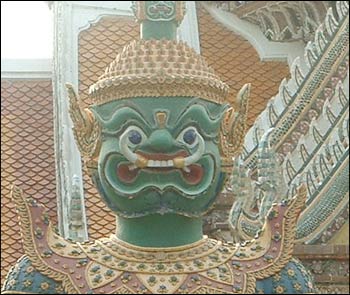
- The Royal Pantheon, with full size statues of the first seven kings of the reigning Chakri dynasty (Rama I - Rama VII). Only open on April 6th, the anniversary of the founding of this dynasty. Surrounding this are large statues of mythical guardians (pictured right), such as the kinaree, half human-half bird and the Hindu garuda bird. It contains the scared Buddhist scriptures, the Tripitaka.

After exiting Wat Phra Kaew, you enter the adjoining Grand Palace.

Thursday, November 6, 2008

LOY KRATHONG ON 12 NOV 2008

LOY KRATHONG

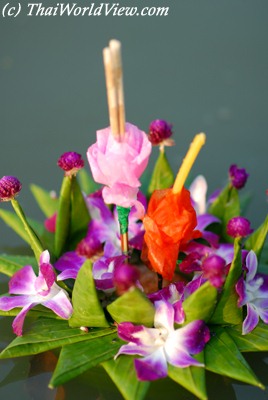
Loy Krathong is as old as Thai heritage and represents a close bond between Thai culture and water. The festival takes place on the full moon night of the twelfth lunar month when the water level is high and the climate is cooler. Participants ask water spirits to sail away their troubles in their krathongs, which are containers traditionally made from banana leaves and carrying offerings of incense, lotus flowers and small money.

Loy Krathong
The festival of Loy Krathong is a time to pay our respects to the Goddess of Water by floating candles and joss-sticks.
Krathong

Nowadays the base of the Krathong tends to be made from synthetic materials and, despite efforts to ban environmentally unfriendly floats, rivers and waterways are often covered with unsightly pieces of styrofoam in the next morning.

Traditionally Krathong were made of banana leaves, the bark of a banana tree or spider lily plants, into which would be placed offerings of food, betel nuts, flowers, candles, joss-sticks and coins.
Loy Krathong

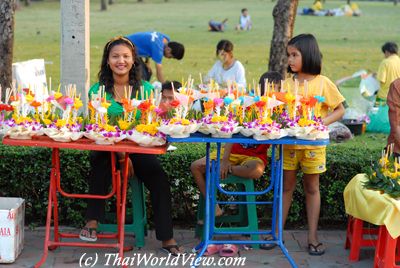
Krathong sellers

In year 2006, more people had turned to krathongs made from natural materials. More than eight out of every 10 krathongs recovered were made from these materials. Just 19 per cent of collected krathongs were constructed of polystyrene foam. Nevertheless, those made from bread constituted a tiny proportion of all floats. The city said bread krathongs dissolved in waterways and provided food for aquatic life.